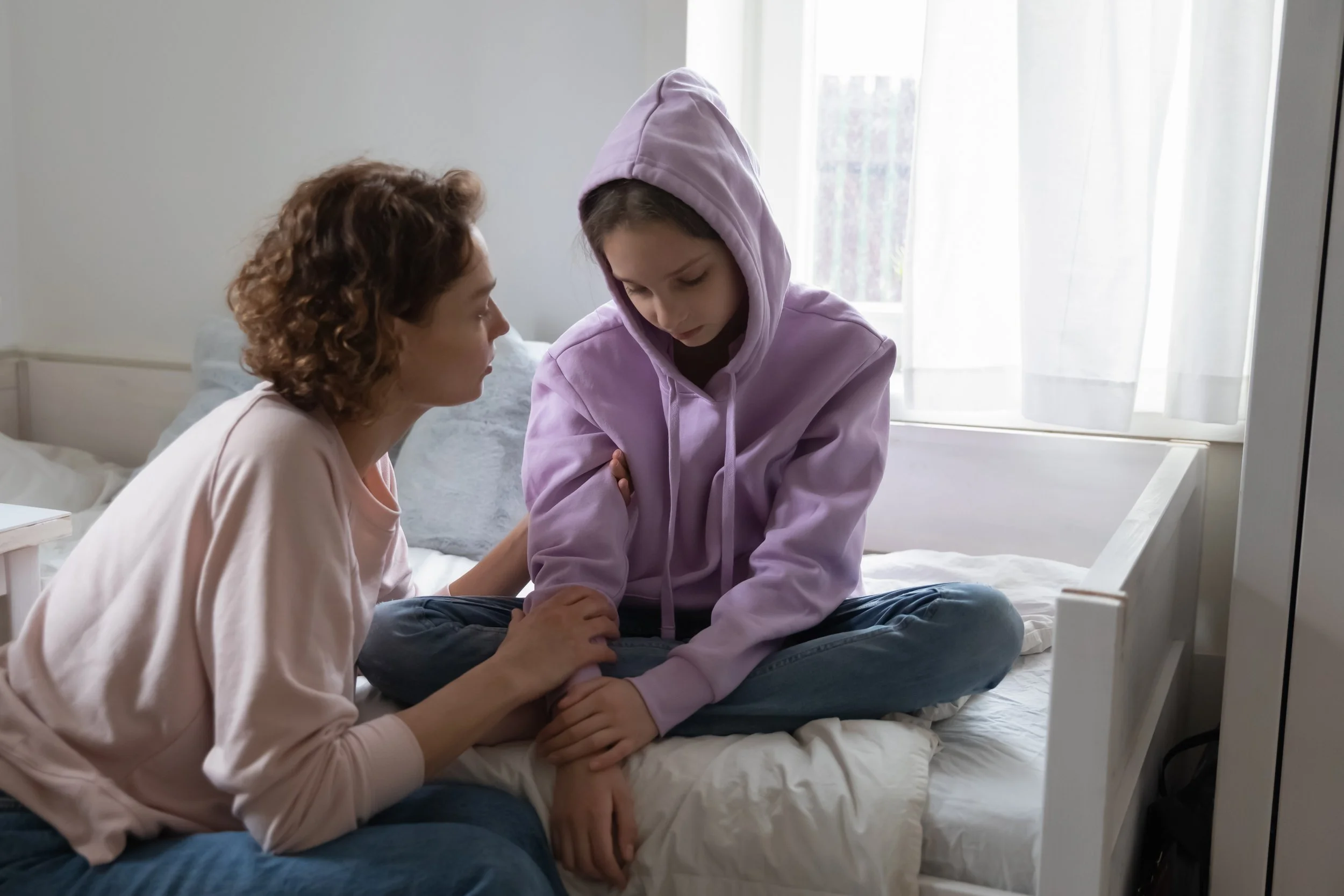
Body Watching, Mirroring mischief, and boundaries.
For English or French subtitles, click the ⚙️ settings icon and select CC/subtitles.
Body Watching & Mirroring
One of the most important skills we develop over time, is the art of being able to hold or manage our own regulation, arousal (anticipation, excitement) and dysregulation.
At the start of life we need to experience, feel and show our emotions and reactions, to signal what is going on inside us and seek support i.e to be read and understood by our loved ones. We are also learning something new moment by moment which means that we are often in a state of arousal and anticipation (which is necessary to learn), 'wired' and alert, in between regulated (7) and dysregulated or overstimulated (10+).
Our loved ones help us to hold the aroused state without sliding in to being overstimulated whilst also allowing us to feel extreme emotions (being overstimulated) and ‘managing’ them, so that throughout life we can remain alert to the world, it’s pleasures and dangers, whilst embracing and holding steady through delights and challenges. Their support of us feeling and managing our own state of regulation helps us to ‘internalise’ the skill and develops our independence, perseverance and self-confidence.
Without knowing it we learn from one another by tuning in to and copying each other. This starts firstly through our bodies, actions and emotions upon which we then build language and words.
We need our parents to hold us steady through our excitement, so that we can organise all of our skills, drink the new information, remain relaxed (regulated) and continue exploring.
We rely on our loved ones ‘subliminal’ messages i.e their energy, body language and face. We watch the adult to help us to know we are safe(If mum'/dad are calm then there can’t be a threat anywhere) and without knowing it, we ‘mirror’ that feeling of safety. Their calm energy, calms us and we feel safe carrying on exploring and developing our skills.
As parents, we show that we are tuned in to what our child is ‘feeling’ and thinking e.g excitement, upset etc. by momentarily mirroring their facial expression (*attuning) and then showing a calm ‘safe face’ (purposefully misattuning) to show them we understand how they are feeling, that these feelings are important , ok and manageable. Our calm energy magnetises them in to the same feeling of calm and by them experiencing their emotions and magnetising out of them they become increasingly able to hold their own calm and feel and ease out of major emotions. The more they experience with parental support the easier it becomes to anticipate, recognise and manage those emotions before they become explosive.
If the adult looks tense, anxious or overstimulated the child will sense and read their 'state' as a signal that something is not quite right (and therefore ‘not safe’). The child will mirror/copy them, becoming increasingly alert to ‘the danger’ and increasingly dysregulated. It doesn’t occur to the child that they may be causing these reactions in the parents face. The child just sees the signal and becomes increasingly ‘chaotic’ and reactive. The more noise there is, the more ‘dysregulated’ both child (and parent) are likely to become.
Children show internal dysregulation through their actions e.g. biting, hitting out, shouting, screaming, jumping, racing around, flapping their hands, repeating phrases, and sentences, becoming dysfluent or by looking ‘fearful’ and ‘withdrawn’
If we can hold steady and stay silent then the chaos the child is feeling and expressing is not fed. By mirroring the child’s face in our own we show that we understand how they are feeling, and that we have heard After a moment we show calm on our face (purposefully mistune), regulating down, easing the child away from their ‘aroused’ state, showing that it’s ok to show and feel those feelings, that they are not overwhelming and that they can be managed in this way.
Each child feels their emotions acknowledged, mirrors and feels the calm and experiences that however extreme the emotion feels, those feelings are not overwhelming, out of their control, but are natural emotions that can be managed.
As our child calms, we start to feel calmer too, our calm feeding theirs, which in turn feeds ours etc. Moment by moment supporting and influencing one another. We are managing our and each others’ emotions.
As a child, as we learn to self calm or self regulate with the support of an adult, so we start to be able to do it for ourselves (internalise). Through our parents we experience how to feel and manage many internal ‘states’ . As we increasingly experience our own calm, so we become more able to feel and anticipate when we are moving up the regulation scale and we become increasingly able to anticipate and inhibit/manage extreme reactions
With every ‘quiet time’ spent at home each child is mirroring the ‘behaviours’ of their parents. They then do the same with other people in other situations, becoming a ‘mini me’ sharing with others what you have shared with them.
The Mischief Maker shaping boundaries.
It's all very well someone saying follow what they do, wait and watch and when they look up - say something but :
What about the child that doesn't seem to sit still for a minute, is always up to mischief and seems to want to ‘wind us up all the time’?
A natural adult reaction is to want to tell them or teach them how to behave, so that they don't cheese other people off and get in to trouble.
Children that do all of this are not deliberately getting in to trouble.
Children are by nature very inquisitive and energetic (it’s their engine for learning). The hard thing for them is learning to regulate, being calm. It requires extra effort to settle and focus, regulation developing over time.
If they are very busy all the time, their energy (without us knowing) is always potentially pulling us ‘up’ , in to the red. When anyone is in the red (child or adult) they react.
Below the level of consciousness their action (habit) gets a reaction (reinforcement) from us. Even though we don’t intend it to.
Below the level of consciousness Reinforcing any action leads to it happening again, and again, and again. See more on regulation and co-regulation.
Since all of this is unconscious and habit forming, we need to do something different to change the habit.
Some of us are born sensing and seeing and being ‘more’ stimulated than others, whilst others of us are born ‘less’ stimulated by everything. We are all different in the way our different senses tune in and notice things.
In addition, children who have experienced more during their development history will have found it harder to manage their own energy and calm, partly because they have had to deal with more and are likely having to work ‘harder’ at co-ordinating and organising their little ‘system’. They may often seem to find it difficult to settle, racing around, quickly going in to an overwhelmed state appearing ‘angry’ or ‘upset’ or ‘frustrated’, ‘striking out ‘ or having frequent ‘melt down’s. When they start to get 'wired' their energy will automatically, below the level of consciousness, draw other people up. Without knowing it we may automatically copy (mirror), go tense in our body and face, and we both go in and remain in chaos.
If a child is often dysregulated, then people around them e.g in Nursery may automatically mirror and feedback dysregulation without meaning to. So when our child face watches, instead of a smiling face, the adults face is tense.
The child sees a tense face which indicates to the child that the adult is not feeling ‘safe’ and that there must be something near that they should fear. Both child and parent spiral upwards, with no means of regulating.
Children with communication delays and differences are in the process of developing their ‘self-regulation’ and require even more support in learning how to manage their state and calm themselves. They need additional support in knowing that a rush of feeling/emotion (excited, angry, tired, sad) is a natural sensation not something to be ‘fearful of’
They need really strong, consistent examples from us to show that they are safe during this overwhelming natural rushes which each child will express through, shouting, crying, rushing, sometimes hitting out, or through going motionless, withdrawing etc.
It takes time to support them in managing these feelings, knowing that they are not negative, but natural. It is particularly exhausting for the adult, because our energy will be wanting to mirror theirs being pulled towards a dysegulated state. By holding steady and not going up with their energy, we provide a safety magnet down, we ‘mask’ how we are feeling in order to hold them steady through and out of the ‘rush’. By us showing we are not concerned by their emotions, actions, they don’t feel so overwhelmed and though mirroring theymanage themselves through and back in to a regulated state.
At first, staying in the green and not being pulled in to the red is exhausting, but the more we magnetise down, the shorter the frequency and length of outbursts will occur
We are not using voice but we are still keeping clear and consistent boundaries. We want to be clear about what is ok and what is not ok.
Using voice - feeds the habit. Once we comment on something, it will grow. Every time they shout and we use voice back we feed the habit. They will do it more.
When they are ‘acting out’ they aren’t tuned in to what we say but they have been reinforced by our voice.
We reduce behaviours we don’t want to grow by showing that we have seen and understood why they are cross, upset, excited etc, showing we can see and hear -’safe face’ (not a smile, but not a negative face either) and are waiting, holding the moment. Not using any voice. They will stop what they are doing,. our calm face will regulate them down and they will then ‘court us’ positively (they are likely to be regulated when they do so) - by face watching, vocalising, bring us something, we smile, nod, and respond with a word ‘shoes’.
They have managed the moment by us giving them time (and safety) to do so. When they are calm they will start to play again, and ‘court us positively ‘ with a face watch and a smile with us face watching, smiling back and responding with a word reinforcing their regulation and interaction. Our voice reinforces the behaviours we want to grow.
We are building clear consistent boundaries and shaping behaviours
This is really tiring in the early stages and takes time...
Five minute sessions can keep our sanity.
Wait for them to settle and settle opposite them in the listening space.
If they walk away, Stay rooted, let them walk off . Don't follow that behaviour and don’t call their name or try to distract them.
Look interested in what you were just doing together on the floor and wait (regulating).
They will choose to come back and as they head towards you they will face watch - 'light up' with a smile and they will come and join you and sit back down. They think they are managing you.
Stay quiet and let them explore with the thing that you are sharing and when they are ready they will face watch and possibly vocalise - 'light up' and say a word or repeat the word you know they are saying or the last word of the sentence they have just said. You being with them and opposite absorbed in what they do supports them in settling. When they get up to go off again, don't call them (or feel rejected), stay interested in what you were both sharing. They will potter off and then return and face watch - 'light up'........etc, etc
With each day they will stay longer and longer.
They will learn how to court you with their face, smile, gestures and vocalisations.
And will forget to do something mischievous to get your attention.
If they are doing something dangerous, move the object or move them (protect them). Still don’t use voice. They will face watch name the action you have just taken with them e.g. having got them off the table - ‘down‘ or ‘off’, having lifted them from under the table ‘out’ .
In this way you have allowed them to stop what they are doing, to sort it out (repair the situation) and are then reinforcing them for doing so.
Continued Reading: